Odoo Pricing Breakdown: Licenses, Hosting, and Implementation Costs
When businesses search for odoo pricing, they are usually trying to answer a very practical question: What will Odoo really cost us—not just today, but over the next several years?
Odoo is often positioned as a cost-effective and flexible ERP platform, especially compared to traditional enterprise systems. While this reputation is well-earned, Odoo pricing is frequently misunderstood. Many organizations focus on the per-user license fee and underestimate the importance of hosting, implementation, customization, and long-term operational costs.
This comprehensive guide from Havi Technology provides a clear, end-to-end breakdown of Odoo pricing, covering licenses, hosting options, and implementation costs in detail. It is written for founders, CFOs, operations leaders, and IT managers who want realistic numbers, transparent explanations, and decision-ready insight.
By the end of this article, you will understand:
- How Odoo licensing works and what you actually pay for
- The cost differences between Odoo hosting options
- What drives Odoo implementation costs
- How these components interact to form total cost of ownership (TCO)
- How to budget accurately for an Odoo project
1. Understanding Odoo Pricing: Why a Breakdown Matters
Odoo pricing is not a single fee—it is a stack of interrelated cost components. Businesses that fail to break pricing down properly often face:
- Budget overruns
- Unexpected post–go-live costs
- Reduced ROI from their ERP investment
A realistic Odoo budget must account for three primary pillars:
- Licensing costs
- Hosting and infrastructure costs
- Implementation and services costs
At Havi Technology, we emphasize that these three pillars must be evaluated together. Optimizing one while ignoring the others often leads to higher long-term costs.
2. Odoo Licensing Costs Explained
Licensing is usually the first cost businesses encounter when researching Odoo pricing. It is also the most visible—and the most misunderstood.
2.1 Odoo Community vs Enterprise Licensing
Odoo offers two main editions:
Odoo Community Edition
- Open-source
- No licensing fees
- Self-hosted only
Odoo Enterprise Edition
- Paid subscription
- Per-user pricing
- Access to advanced features and official updates
While Community Edition is free to use, it is not free to operate. Most businesses evaluating ERP systems seriously end up choosing Enterprise due to lower operational risk and better long-term scalability.
2.2 How Odoo Enterprise Licensing Works
Odoo Enterprise pricing is based on:
- Number of internal users
- Billing cycle (typically annual)
Each internal user who logs into the system requires a paid license. This includes staff in accounting, sales, inventory, manufacturing, and management.
Important licensing considerations:
- External portal users (customers, vendors) usually do not require licenses
- Licenses are renewable annually
- User count can be adjusted at renewal
Proper role-based access planning can significantly reduce licensing costs over time.
2.3 What the License Fee Includes
The Odoo Enterprise license covers:
- Access to Enterprise-only features
- Security patches and bug fixes
- Official version upgrades
It does not include:
- Implementation services
- Custom development
- Data migration
- Training or user adoption programs
This distinction is critical for accurate budgeting.
3. Odoo Enterprise Plans and Their Cost Implications
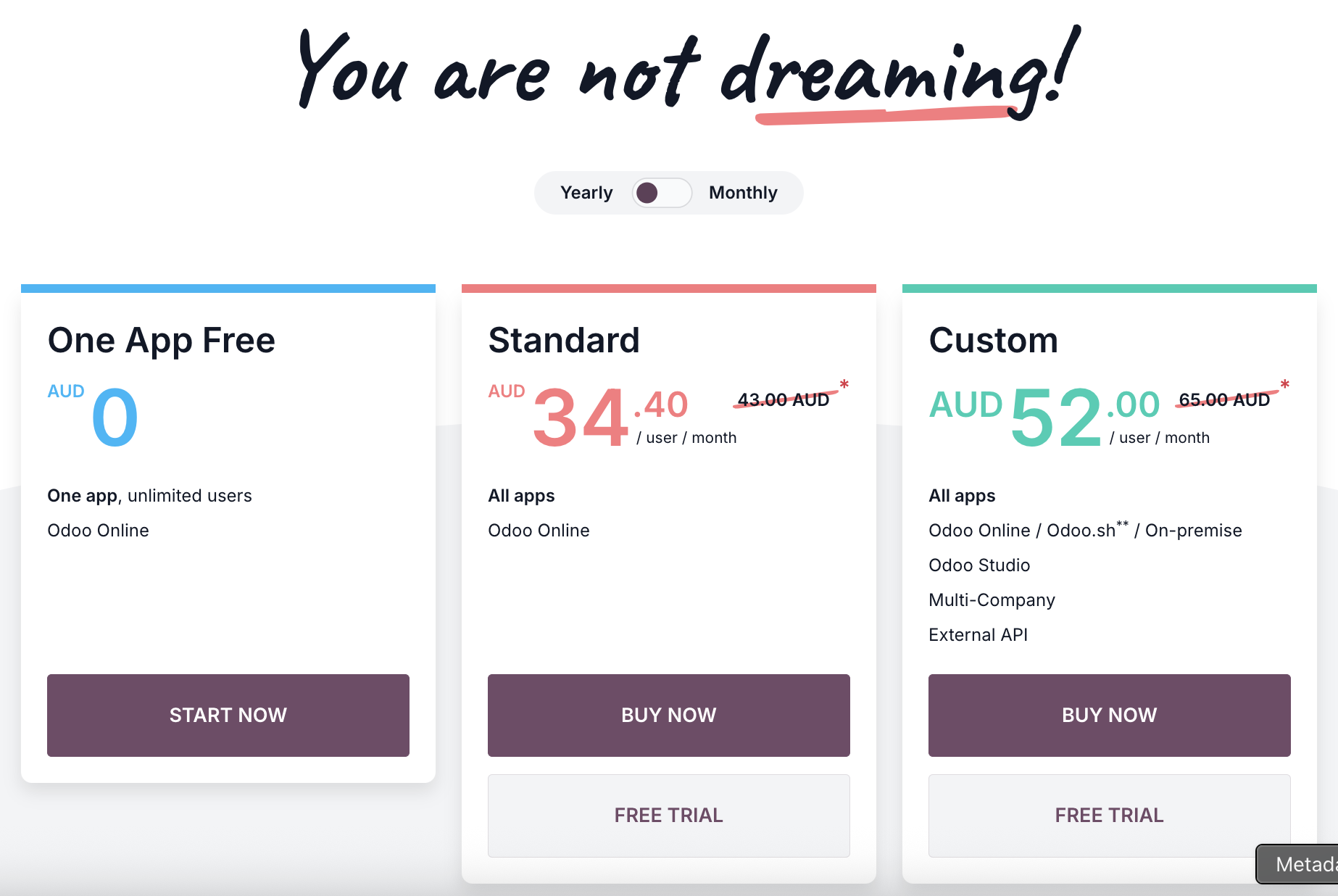
Odoo Enterprise is offered under several plans, each affecting pricing differently.
3.1 One App Free Plan
The One App Free plan includes:
- Unlimited users
- One Odoo application
- Hosting on Odoo Online
This plan is best for:
- Startups testing a single function (e.g., CRM or invoicing)
- Very limited operational scope
It is not designed for multi-department ERP usage.
3.2 Standard Plan
The Standard plan offers:
- Access to all Odoo applications
- Per-user licensing
- Hosting on Odoo Online
This is the most common plan for small and mid-sized businesses with:
- Standardized processes
- Minimal customization needs
3.3 Custom Plan
The Custom plan includes:
- All Odoo applications
- Odoo.sh or on-premise hosting
- Full customization and API access
This plan is designed for:
- Growing companies
- Manufacturing and distribution businesses
- Organizations requiring integrations and advanced workflows
While the Custom plan has higher upfront costs, it often delivers better long-term value for complex environments.
4. Hosting Costs: A Critical Part of Odoo Pricing
Hosting is the second major pillar of Odoo pricing and one of the most overlooked.
4.1 Odoo Online (SaaS Hosting)
Odoo Online is:
- Fully managed by Odoo
- Included with Standard plans
- Simple and cost-effective
Advantages:
- No infrastructure management
- Predictable costs
- Fast deployment
Limitations:
- Restricted customization
- No access to server-level control
Odoo Online is ideal for businesses prioritizing simplicity and cost control.
4.2 Odoo.sh (Managed Cloud Hosting)
Odoo.sh provides:
- Managed cloud infrastructure
- Separate production, staging, and development environments
- Git-based deployment workflows
Costs depend on:
- Number of workers
- Storage usage
- Environment complexity
Odoo.sh is commonly used in projects managed by Havi Technology, especially when moderate to advanced customization is required.
4.3 On-Premise Hosting
On-premise hosting offers:
- Maximum control over data and infrastructure
- Compliance with strict regulatory requirements
However, it introduces:
- Hardware and infrastructure costs
- Internal IT staffing needs
- Security and backup responsibilities
For most SMEs, on-premise hosting increases total cost of ownership without delivering proportional value.
5. How Hosting Choices Affect Total Cost of Ownership
Hosting decisions directly impact:
- Operational overhead
- Scalability
- Long-term maintenance costs
While Odoo Online offers the lowest upfront cost, Odoo.sh often provides the best balance between flexibility and operational efficiency. On-premise hosting should be chosen only when there is a clear regulatory or strategic requirement.
6. Implementation Costs: The Largest Component of Odoo Pricing
For most organizations, implementation costs exceed licensing and hosting costs combined.
6.1 What Odoo Implementation Includes
A comprehensive Odoo implementation typically involves:
- Business process analysis
- ERP system configuration
- Data migration from legacy systems
- User roles and access control
- Testing and quality assurance
- User training and go-live support
Each of these activities contributes to overall cost.
6.2 Implementation Cost Drivers
Key factors influencing implementation cost include:
- Number of modules deployed
- Complexity of business processes
- Data quality and migration scope
- Customization and integrations
- User training requirements
6.3 Typical Implementation Cost Ranges
While costs vary widely, general ranges include:
- Small businesses: low to mid five figures
- Mid-sized organizations: high five figures
- Large or complex enterprises: six figures or more
At Havi Technology, we emphasize phased implementation to control cost and risk.
7. Customization and Integration Costs
Customization is often where Odoo pricing can escalate if not managed carefully.
7.1 Configuration vs Custom Development
- Configuration uses standard features and minimizes cost
- Custom development increases flexibility but raises long-term maintenance expenses
A configuration-first approach is usually more cost-effective.
7.2 Third-Party Applications
Odoo App Store modules can:
- Accelerate implementation
- Introduce recurring subscription fees
- Increase upgrade complexity
Each third-party app should be evaluated for long-term value.
7.3 System Integrations
Common integrations include:
- Accounting and payroll systems
- E-commerce platforms
- Logistics and shipping providers
Integrations add both initial and ongoing costs.
8. Ongoing Costs After Go-Live
Odoo pricing continues well beyond implementation.
8.1 Support and Maintenance
Ongoing support may include:
- Issue resolution
- Performance optimization
- User assistance
Support costs depend on:
- SLA requirements
- System complexity
8.2 Upgrades and Version Management
Annual Odoo upgrades require:
- Testing
- Code refactoring
- Data validation
Well-designed systems reduce upgrade costs.
8.3 Scaling Over Time
As businesses grow:
- User licenses increase
- Hosting resources expand
- Governance becomes critical
9. Putting It All Together: Total Cost of Ownership Scenarios
9.1 Small Business Scenario (5–10 Users)
- Enterprise licenses
- Odoo Online hosting
- Minimal customization
Lowest overall cost scenario.
9.2 Growing Business Scenario (20–50 Users)
- Standard or Custom plan
- Odoo.sh hosting
- Moderate integrations
Balanced cost-to-value profile.
9.3 Enterprise Scenario (100+ Users)
- Custom plan
- Advanced hosting or on-premise
- Extensive customization
Highest cost, but maximum scalability.
10. Common Odoo Pricing Mistakes to Avoid
- Focusing only on license fees
- Underestimating implementation effort
- Over-customizing early
- Choosing hosting without long-term planning
Avoiding these mistakes protects ROI.
11. Is Odoo Worth the Cost?
Odoo is worth the investment when:
- Requirements are clearly defined
- Customization is disciplined
- Long-term governance is in place
It may not be suitable if:
- You expect ERP to work without process change
- You underestimate internal ownership
12. Final Thoughts: Building a Clear Odoo Pricing Strategy
Understanding Odoo pricing requires looking beyond surface-level numbers. Licenses, hosting, and implementation costs are deeply interconnected, and optimizing one at the expense of the others often increases total cost of ownership.With proper planning, Odoo can be one of the most cost-effective and scalable ERP platforms available. At Havi Technology, we help businesses design Odoo solutions that align pricing with real operational value—ensuring your ERP investment supports growth rather than constraining it.
If you’d like, I can also create a detailed Odoo pricing calculator, a downloadable budgeting checklist, or a CFO-focused executive summary based on this guide.
